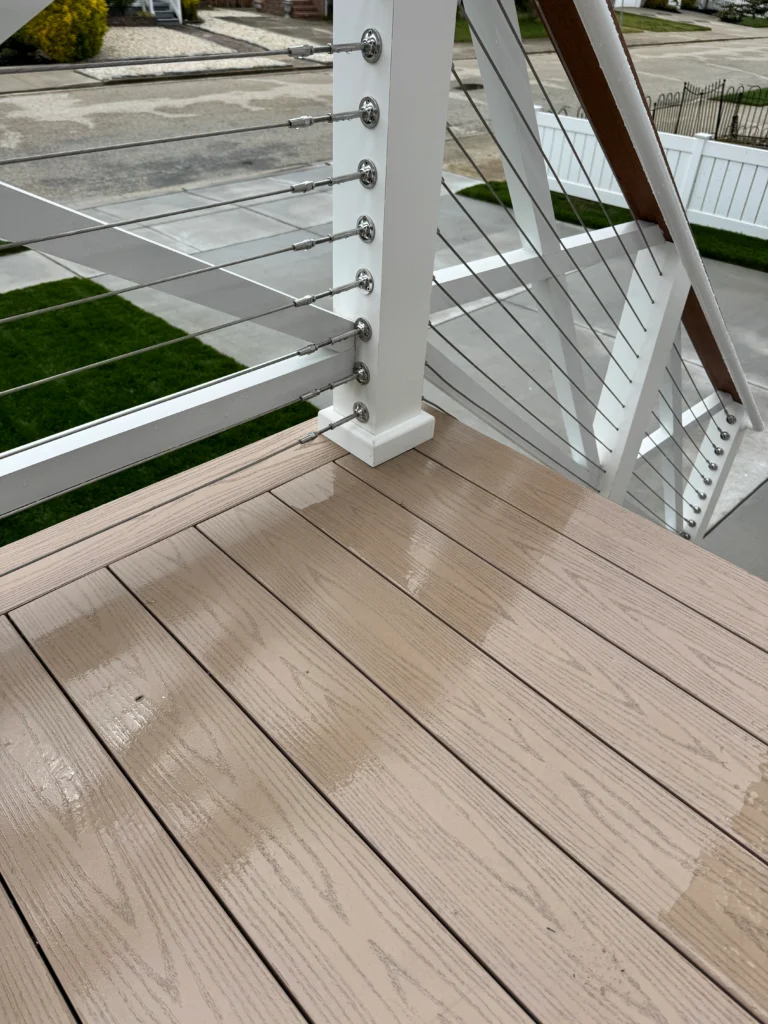
Why we always build picture frame decks in our home builds in brigantine

Building A Home? Make Sure The Deck Looks Gorgeous

Picture Frame Deck Boards vs. Straight Cuts: What Actually Looks Better and Lasts Longer

If you are building a new home in Brigantine or nearby on the islands, you likely have spent weeks choosing the ideal deck boards, the color, the brand, composite vs. wood, and then give about thirty seconds of thought to how those boards end at the edge. That last detail, the border treatment, is one of the biggest visual differences between a deck that looks custom built and one that looks like it was slapped together over a weekend.

There are two standard approaches: picture framing and straight cuts. One wraps a finished border around the perimeter of the deck. The other runs the field boards straight to the edge and calls it done. Both are structurally sound. But the difference in how they look, hold up, and handle coastal weather is significant enough that it’s worth understanding before your deck goes down.

As a custom home builder in Brigantine, we plan the deck as part of the home design, not as an afterthought once the house is standing. That means the border detail gets decided during the design phase alongside the floor plan, the elevation, and the structural engineering. We’ve built both styles on new construction and coastal renovations across the barrier islands, and we have strong opinions about when each one makes sense.

What Is a Picture Frame Deck?

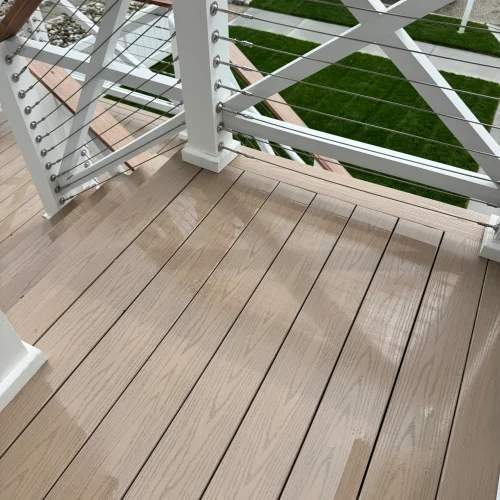
A picture frame deck essentially has border board (or boards) installed around the full perimeter, running perpendicular to the field boards. These field boards are then cut to fit neatly inside that frame, with their ends hidden behind the border. The end result looks like a picture inside a frame, clean edges on all four sides, no visible board ends, and a deliberate, finished appearance.

The framing board is typically the same material as the field boards but can be a contrasting color for a more dramatic effect. On composite decking, this contrast option is especially popular because manufacturers offer coordinating accent colors designed specifically for border applications.

The key structural difference is that picture framing requires additional blocking underneath the border boards. The framing runs perpendicular to the joists in at least two directions, which means the substructure needs extra support members to carry that load. It’s not complicated for a builder who plans it into the framing from the start, but it’s exactly the kind of detail that gets skipped when the deck is treated as a separate project from the new home build. When we design a new home, the deck substructure is part of the structural drawings before ground is broken.

Single vs. Double Picture Frames

A single picture frame uses one border board around the perimeter. This is the most common approach and works well on decks of any size. It adds a clean, defined edge without being overly decorative. For most residential decks in the 200 to 500 square foot range, a single frame is the right call.
A double picture frame adds a second border board inside the first, creating a wider, more substantial edge detail. This works best on larger decks where a single board border would look proportionally thin. It also opens up the option for a two tone color scheme, an outer border in one shade and an inner border in another, with the field boards as a third color.

On elevated homes, which are particularly common in Brigantine and the barrier islands, where the deck is often the first thing visitors see from street level, a double picture frame adds the kind of visual weight that makes the entire structure feel intentional.
 
Most of our new construction in Brigantine, Longport, and Margate features raised foundations and reverse living layouts, which means the deck and its edge detail are visible from the ground. On a home like that, a single border can look thin from 12 feet below. A double frame gives it the visual presence it needs.

A Picture Frame Just Feels More Complete Visually

The obvious advantage to building a picture frame deck is appearance. Hiding board ends behind a border eliminates the row of cut edges that you see on a straight cut deck. Board ends are where composite decking is most vulnerable to moisture absorption, and where natural wood shows the most exposed grain. Tucking those ends behind a frame board keeps the cleanest face of every board visible.

But there’s a practical benefit that most people don’t think of. Board ends are where the expansion and contraction are most visible. Composite decking expands and contracts with temperature changes, and over a 12 or 16 foot run, the cumulative movement shows up at the ends. On a straight cut deck, that means gaps opening and closing at the visible edge of the deck throughout the year. On a picture frame deck, that movement happens behind the border board where nobody sees it.

In a coastal environment here on the island where a deck might see 40 degree mornings in January and 95 degree afternoons in August, that thermal cycle is real. A picture frame border absorbs and conceals it. This is one of the reasons we default to picture framing on most of our custom home builds in Brigantine unless requested otherwise as the combination of salt exposure, UV, and temperature swings puts every material and every joint to the test.

Materials That Work Best for Picture Frame Decking

Picture framing works with any decking material, but composite boards tend to handle it best for a few reasons.

Using Composite boards, they are manufactured to consistent dimensions. Every board is the same width and thickness, which means the gaps between the field boards and the frame stay uniform across the entire deck. With natural wood, slight dimensional variation and seasonal swelling can create uneven gaps that undermine the clean look you’re going for.

The major composite brands, Trex, TimberTech, and Fiberon, all offer fascia boards and accent colors designed for picture frame borders. These are typically the same material composition as the field boards but in complementary shades. That means matching warranty coverage across the entire deck surface, border included.

For coastal builds, we also look at the fastening system. Hidden fasteners are standard on most composite installs, but the border boards in a picture frame design are typically face screwed (plugged and covered with color matched plugs or screwed from underneath where possible). Getting this detail right is what separates a sharp looking frame from one with visible screw heads marching around the perimeter. It’s the kind of thing a home builder thinks about during design. A deck company working after the fact usually doesn’t.

Straight Cut Boards Make Sense.. Sometimes

We’re not going to pretend picture framing is always the right answer. There are situations where running the boards straight to the edge is the better call. Typically when one of these factors is at play.
 
– You are making a smaller deck or simple rectangle:
On a compact deck, a picture frame border can make the space feel smaller by visually boxing in the field area. If the deck is 10 by 12 or under, straight cuts keep the proportions clean and let the deck feel as large as possible.
 
– You have a tight budget on your new build: 
Picture framing adds labor time and cost. The additional blocking, the precise field board cuts, and the border installation itself add roughly 10 to 15 percent to the labor portion of the deck. On a budget sensitive project, that money might be better allocated elsewhere, like better quality boards or upgraded railing.
 
– The boards are already running parallel:
If the deck boards are already running parallel to the house and terminating at a fascia board on the exposed side, the edge is already clean. Adding a picture frame in that scenario is purely decorative and may not justify the cost.

Why Your Deck Should Be Built By Your Home Builder

This is the kind of decision that shows up in every McHugh Builders project. It’s a fine detail, not a structural necessity, but it’s the accumulation of details like this that determines whether a finished home looks custom built or builder grade.

When the same team designing your home is also engineering and building your deck, the substructure, the board layout, the border detail, and the material selection all get coordinated as one system. The deck framing ties into the house framing. The fastener spec matches the rest of the exterior. The elevation and drainage work together, not against each other. That doesn’t happen when you hand the deck off to a separate contractor after the certificate of occupancy.

It’s the same philosophy behind using 5/8″ drywall instead of 1/2″ throughout every home we build. It’s why we spec stainless steel fasteners on every exterior application in the salt air zone. It isn’t a necessity, but it is how we prefer to do things here at McHugh Builders because it results in a better end product.

A picture frame deck border takes maybe an extra day on a typical residential deck. The visual difference lasts the life of the home. For clients building a custom home in Brigantine, Longport, Margate, or Ventnor, where the deck is often the largest outdoor living feature and the first thing guests see, that’s an easy trade.

Commonly Asked Questions About Picture Frame Decking

Picture frame decking is a border treatment where one or two boards are installed around the perimeter of a deck, running perpendicular to the field boards. The field boards are cut to fit inside this frame, hiding the board ends and creating a clean, finished edge on all sides. It works with both composite and natural wood decking.
Yes, but less than most homeowners expect. The material cost increase is minimal since you're only adding border boards and blocking. The real cost is additional labor, typically adding 10 to 15 percent to the deck installation portion of the project. On a $15,000 deck build, that's roughly $1,500 to $2,250 in extra labor for a detail that significantly elevates the finished look.
Absolutely. Composite decking is actually the ideal material for picture framing because the boards are manufactured to consistent dimensions, which keeps the gaps between field boards and the frame uniform. Trex, TimberTech, and Fiberon all offer accent and fascia boards specifically designed for border applications, often in contrasting colors.
A double picture frame uses two border boards around the perimeter instead of one. This creates a wider, more substantial edge detail and allows for two tone color combinations. Double frames work best on larger decks where a single border board would look proportionally thin. They're common on elevated coastal decks where the edge detail is visible from below or from the street.
Picture framing offers a practical advantage in coastal environments beyond aesthetics. Board ends are where composite decking is most vulnerable to moisture and where thermal expansion is most visible. A picture frame border hides those ends behind a perpendicular board, concealing the expansion gaps that open and close with temperature swings. In Brigantine, Longport, Margate, and other barrier island communities where decks see extreme temperature ranges and salt exposure, this keeps the deck looking cleaner longer. Most custom home builders on the NJ shore default to picture framing for this reason, it's a standard detail in quality coastal new construction.
If the deck is part of a new home build or a major renovation, having your home builder handle the deck means the substructure, drainage, and material specs are coordinated with the rest of the project. The deck framing ties into the house framing, the fastener specs match, and the border detail is planned during design rather than figured out on site. For standalone deck additions on an existing home, a dedicated deck company can work, but you lose that integration.

Build It Right The First Time

If you’re planning new construction or a major renovation on the barrier islands, the deck border detail is worth getting right from the start, not added as an afterthought. When we build a custom home in Brigantine or the surrounding shore towns, the deck is part of the project from day one, designed alongside the floor plan, the elevation, and the structural engineering. That’s how you end up with a finished product where every detail, inside and out, feels like it belongs.

Give us a call at (609) 513-9269 or reach out through our website. Whether you’re building a new home from the ground up or renovating an existing one, we’ll walk through your deck plans, the material options, and whether a picture frame border makes sense for your project.

Schedule A Consultation

Reach out today and Ted McHugh will be in touch very soon!