
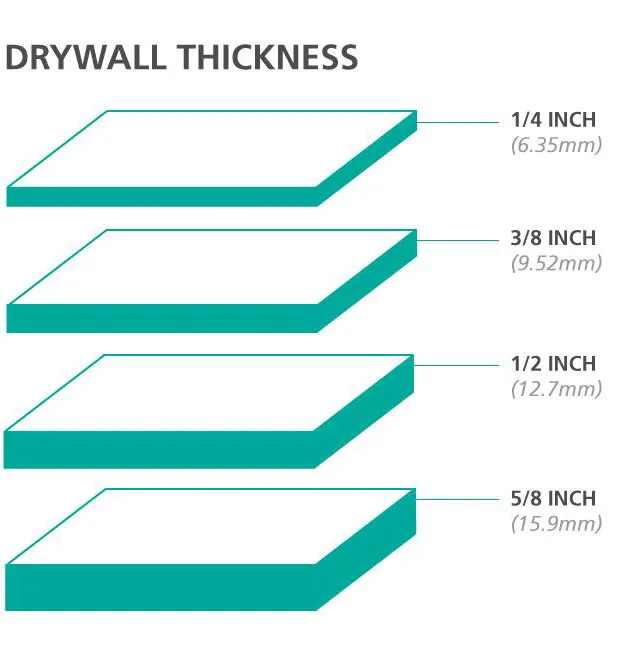
Most homeowners never think about drywall. It’s behind your paint, above your head, and completely invisible once the house is finished. But the thickness of the drywall in your walls and ceilings plays a major role in how your home feels, sounds, and holds up over time. At McHugh Builders, we use 5/8″ drywall throughout our custom homes instead of the standard 1/2″ that most residential builders default to. It costs a little more. It’s heavier to hang. And it’s absolutely worth it. Here’s why:
5/8″ drywall is denser and more rigid than 1/2″. That extra 1/8″ of gypsum makes the wall more resistant to dents, dings, and the kind of minor impacts that happen in every home — furniture getting bumped down a hallway, kids roughhousing, a doorknob swinging into a wall.
Over time, 1/2″ drywall develops imperfections. Small dents accumulate. Walls lose that crisp, clean look. 5/8″ holds up significantly better, which means your walls still look sharp five and ten years after move-in — not just on day one.
In a coastal environment like Brigantine, where homes experience temperature and humidity swings between summer and winter, that added rigidity also reduces the chance of nail pops and hairline cracks caused by minor framing movement.

This is one of the most underrated differences. 5/8″ drywall has more mass, and mass is what blocks sound transmission. The result: bedrooms are noticeably quieter. You don’t hear every footstep from the floor above. The home just sounds more solid and more private.
Is 5/8″ drywall alone a complete soundproofing solution? No — that requires insulation, resilient channel, and sometimes double layers. But it’s the foundation. And the difference between 1/2″ and 5/8″ is real and audible, especially between floors in a multi-story beach home where the main living area is often directly above the bedrooms (the reverse living layout common in Brigantine construction).
Most 5/8″ drywall panels are Type X — meaning they contain glass fibers and additives that improve fire resistance compared to standard 1/2″ panels. A single layer of 5/8″ Type X drywall provides up to a 1-hour fire rating on certain assemblies.
Building code requires 5/8″ Type X in specific locations: garage-to-living-space walls, ceilings below living areas, and around mechanical rooms. We don’t stop there. By using 5/8″ throughout the entire home, every wall and ceiling benefits from that added layer of protection — not just the ones code requires.
It’s something you’ll hopefully never need. But it’s built into the structure of every McHugh home.
Here’s the one you will notice every day. 5/8″ drywall lays flatter across framing than 1/2″ because it’s more rigid. That means fewer visible waves, less telegraphing of studs, and a cleaner surface — especially under natural light.
Walk through a home built with 1/2″ drywall on a sunny afternoon and look at the walls from a low angle. You’ll likely see subtle waves and imperfections where the thinner board conforms to minor framing irregularities. 5/8″ bridges those gaps more effectively, producing the kind of flat, uniform surface you expect in a high-end home.
This matters even more on ceilings. 1/2″ drywall is known to sag between joists over time, especially at 24″ on-center spacing (common in many Brigantine homes). 5/8″ stays flat — period.
Honestly? Cost and speed.
1/2″ drywall is lighter, cheaper per sheet, and faster to install. A crew can hang more boards per day with 1/2″ than with 5/8″ because each sheet weighs less. For production builders working on tight margins and fast timelines, that math wins out.
And 1/2″ meets code for most interior walls. It’s not wrong — it’s the minimum standard.
But at McHugh Builders, we’re not building to minimum standards, We’re building custom homes that our clients live in year-round or come back to every summer for decades. The difference in material cost for a full home is relatively small — typically a few hundred dollars on a project that’s already a significant investment. The difference in how the home feels and lasts is not small at all.
This is part of a broader philosophy we bring to every project. The structural hold-downs you’ll never see behind the drywall. The PVC-mounted electrical meters that prevent siding damage. The way we picture frame decks for a cleaner look. And yes — the 5/8″ drywall that makes every wall and ceiling in your home stronger, quieter, and better looking.
These are the decisions that separate a home built to code from a home built to last. If you’re thinking about building a custom home in Brigantine or the surrounding barrier islands, give us a call at 609-513-9269. We’re happy to walk you through what goes into a McHugh-built home — including the stuff behind the walls.
Reach out today and Ted McHugh will be in touch very soon!